Guided Tissue Regeneration Washington DC & Alexandria VA
Guided Tissue Regeneration Washington DC & Alexandria VA
Periodontal disease is a common inflammatory condition that affects the gums and supporting bone around the teeth. If left untreated, it can lead to symptoms like swollen or bleeding gums and may eventually contribute to bone loss, loose teeth, and a patient losing their teeth entirely.
Guided Tissue Regeneration (GTR) is a technique used to support the growth of new bone and gum tissue around the teeth. During this procedure, barrier membranes are placed to help guide tissue growth and prevent unwanted cells from interfering with the healing process. GTR is often used to help rebuild jawbone tissue in preparation for dental implants, although it may also be used to repair bone loss after the removal of impacted teeth or cysts.
At Precision Periodontics and Implant Dentistry, our specialty-trained periodontists Drs. Zalewsky, Daru, Gupta, and Lakkis have years of experience treating a wide range of stages of gum disease and placing dental implants. To learn more about guided tissue regeneration and treatment options for gum disease, our clinic facilities, or to schedule an appointment for a procedure, contact our Alexandria, VA office at (703) 823-2422 or our Washington, D.C. office at (202) 296-3360.

Contact Precision Today
Dr. Daru
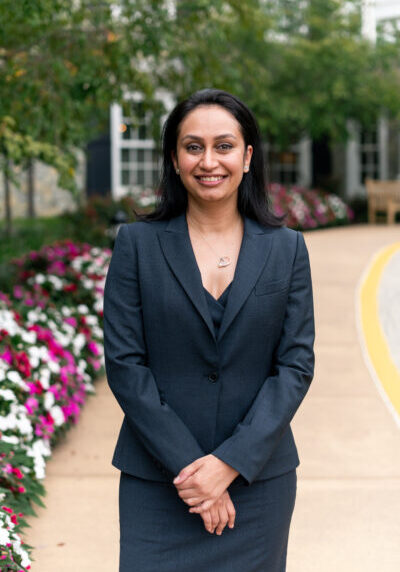
In 2005, Dr. Daru embarked on her educational odyssey, crossing continents to pursue her passion for dentistry. She obtained her Master of Science in Oral Biology and a certificate in Periodontics from the prestigious New York University and the University of Maryland, Baltimore, in 2010. During her academic years, she delved into intensive research, particularly focusing on innovative bone regeneration techniques, showcasing her dedication to advancing the field.

Dr. Gupta
Driven by a dedication to excellence, Dr. Gupta embarked on a transformative periodontal residency at the University of Detroit Mercy. Here, she earned her Master of Science and a certificate in Periodontics while simultaneously serving as an adjunct faculty for the School of Dentistry for three years. Her commitment to advancing dental knowledge took her to an international stage, where she presented groundbreaking research on clinical treatment for gum recession and root coverage at a prestigious conference in London.

Dr. Lakkis
Dr. Dima Lakkis earned her DDS with honors in 2006 and completed her Periodontics training and Master of Science at Case Western Reserve. She is Board Certified and a Diplomate of the American Board of Periodontology. Dr. Lakkis provides a full range of periodontal and implant treatments, with advanced training in cosmetic procedures. She is an active member of several dental organizations and has published in the Journal of Periodontology on the link between periodontal and systemic health.

Dr. Zalewsky
Following his military service, Dr. Zalewsky pursued advanced training at Temple University Kornberg School of Dentistry. There, he earned a Certificate in Periodontics and Oral Implantology, along with a Master of Science in Oral Biology. This comprehensive training equipped him to handle intricate periodontal conditions and complex oral implant procedures with precision and skill.
Reasons for Guided Tissue Regeneration
The most common reason for having guided tissue regeneration is due to the patient having advanced gum disease. Gum disease is an increasingly common issue that is generally preventable, provided you practice good daily oral hygiene habits and schedule regular visits to your periodontist. If left untreated, gum disease can cause a number of issues to develop, which is why it is so important to schedule regular checkups with your periodontist. These regular visits not only provide you with a professional cleaning, it also allow your periodontist to catch problems before they develop into something worse.
If you have not scheduled an exam in some time and are concerned you might have gum disease, the following symptoms are commonly associated with the disease:
- Gums that are swollen and/or red
- Loose teeth or teeth that have shifted
- Receding gums
- Gums that easily bleed
- Halitosis
- Change in your bite
- Change in the fit of dentures
While these are common symptoms and signs that gum disease may have developed, the only way to know for certain whether or not you have gum disease is to schedule an appointment with your dentist or periodontist.
Guided Tissue Regeneration Expectations
Prior to beginning the guided tissue regeneration process, your periodontist will administer a local anesthetic to ensure any potential pain is minimized. Once you are properly numbed, the infected gum pockets will be cleaned, and membranes will be inserted between the pockets and the soft tissue in the bone. Once the membrane is properly positioned, there will be a sufficient amount of space for the bone to begin regenerating, and the area will be stitched shut so the healing process can begin. The membrane and stitches typically dissolve on their own, and it takes approximately six months for the bone to regenerate to the point where it can hold a dental implant.
Guided Tissue Regeneration Aftercare
Following your guided tissue regeneration procedure, it is essential that you follow the aftercare instructions. It is common to experience some discomfort following the procedure, but this can typically be managed with over-the-counter medication, such as Advil or Ibuprofen. Swelling is also common and can generally be addressed through the use of ice packs and anti-inflammatory over-the-counter medication.
Once you have completed the recovery process, the most important thing you can do to prevent the need for this type of procedure in the future is to continue practicing good daily oral hygiene practices. Brush and floss twice daily and schedule regular visits to your periodontist to ensure that your teeth receive regular professional cleanings, which will reduce your risk of developing gingivitis or periodontitis. If you follow these best practices, you will enjoy a bright and healthy smile for many years to come!
Guided Tissue Regeneration Cost
The cost of guided tissue regeneration will depend on a variety of factors, including your dental insurance plan, whether or not additional procedures are required, the severity of your case, and what type of dental sedation (if any) was used.
At Precision Periodontics and Implant Dentistry, we are committed to ensuring that money is not a deterrent to our patients receiving the optimal dental health care they deserve. For this reason, we offer a range of payment options regardless of what type of treatment you are having, which our staff will be happy to explain and assist with. Our office insurance coordinators work with other insurance companies to assist patients with their claims.
For your convenience, Precision Periodontics and Implant Dentistry accepts cash, check, debit, and credit cards (Mastercard, American Express, Visa, and Discover). Our clinic also accepts GreenSky Patient Solutions, a financing option for procedures and treatments not typically covered by insurance or when insurance does not cover the entire cost. We are happy to provide an application in our office. You can find out more information about this service at https://www.greensky.com/patient-faq/.

Providing you with Optimal Care
At Precision Periodontics and Implant Dentistry, we proudly offer outstanding oral healthcare for patients in the Washington, D.C., and Alexandria, VA, areas. In our calm, peaceful environment, we use state-of-the-art equipment to perform advanced procedures designed to achieve optimal results. Because collaboration is a key component of success, we work closely with your primary dentist to deliver the customized treatment and care you deserve.
To schedule your appointment for guided tissue regeneration, contact us today. We look forward to helping you achieve and maintain a bright and healthy smile!